Vintage Locksmith Two Drawer Pin Box
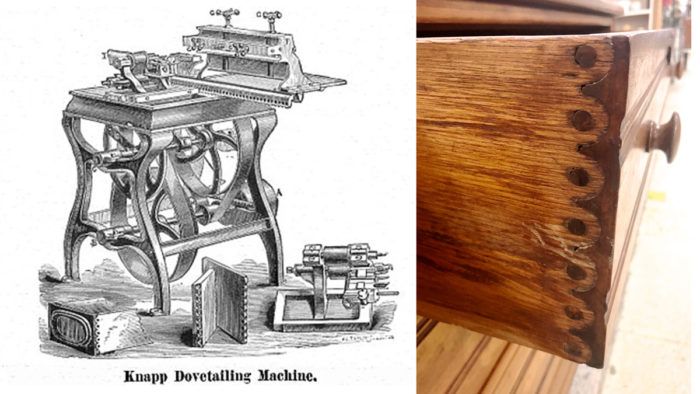
If you have an antique furniture that features drawers with a curious-looking one-half-circle joint, you can be almost certain that information technology was made in a North American factory between 1871 and 1900. While it came to exist known as the Knapp Articulation, the joint is also variously described by its appearance: the pin and cove, scallop and dowel, scallop and peg, pin and scallop, and half-moon.
Why the (rather brief) departure from dovetails? By the second one-half of the 19th century, most article of furniture in America was made by machines in industrialized factories—with the exception of fine drawers. Though people were patenting machines that could produce dovetails (106 patents for the similar practical for between 1833 and 1900!), no one had however developed an appealing way to cut more than one uniform pivot and tail at a time. (See the Burley & Putman Dovetailing machine, patent nos. 12,122 and 26,647)
Meet a modern maker's have on producing a cove-and-pin
joint with common woodworking machinery
High-quality drawers were nonetheless being produced by paw, and while a skilled craftsman could turn out perchance 20 drawers a day, that wasn't nearly fast plenty to go along footstep with the production of furniture for which said drawers were intended. Handwork was holding up the mill output.
Instead of focusing on a auto for cutting dovetails, Charles B. Knapp, of Waterloo, Wis., merely rethought the joint.
His 1867 patent (no. 63,532) describes his inventive approach as "of that class of joints known by the general proper name of a 'tenon and mortise joint,' the item form of the tenon in this instance being in cantankerous-department, round or circular, with the mortise or pigsty of a corresponding shape and size thereto, so that when placed ane within the other they will class a shut and tight articulation." It'due south a series of semi-circles with a hole in the eye cut into the drawer side that match negative semi-circles with integral pegs in the ends of the drawer front.
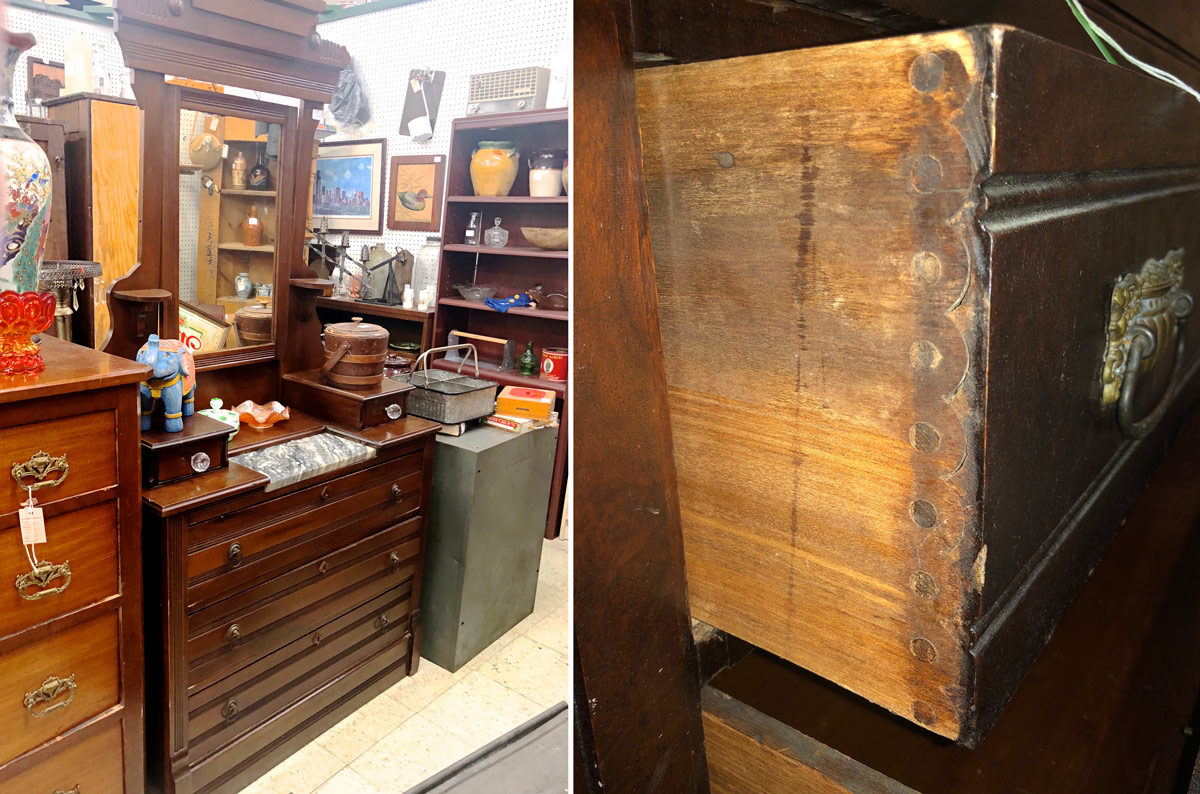
Another Eastlake dresser with Knapp-jointed drawers.
In 1870, Knapp sold the rights to an improved version of his machine (patent no. D4,302) to a grouping of investors who formed the Knapp Dovetailing Company in Northampton, Mass., and he was listed on an 1872 patent (no. 122,390), along with Nathan Due south. Clement, for improvements to the original design. (On an 1888 patent, no. 388,760, Clement is listed as the sole inventor of a "dovetailing car" that rethought the technology, though not the joint itself.)
In 1871, the Knapp Dovetailing Company put the machine into a production line at the Beal & Hooper piece of furniture factory in East Cambridge, Mass., and during the next 30-odd years, the technology was embraced in piece of furniture factories throughout the Northeast, with more modest use in the Midwest and Canada. (Information technology never caught on in the United kingdom of great britain and northern ireland or Europe, where hand-cut dovetailed drawers were produced until the 1930s.)
Advertisements from the machine's heyday merits that information technology could plow out as many as 400 drawers per twenty-four hours, although furniture historian Fred Taylor puts the number at effectually 250. At either rate, it'southward a marked increase over the number of paw-cut dovetailed drawers that could be produced in the aforementioned time.
Taylor writes, the machine, which had 9 cutting heads, "was a complicated affair involving five cut parts. Information technology had an auger, a hollow auger, 2 V-shaped cutters, and a circular cutter. The auger bored the holes in the drawer side, the hollow auger gouged out the pegs from the drawer front, and the rest of the cutters shaped the circles effectually the holes and the pegs."
By 1900, the new and obviously machine-made joint became a victim of piece of furniture fashion—and by then, in that location was machinery that could cut a traditional-looking dovetail joint. While the curvilinear Knapp joint fit right in with the exuberant decorative excess of Eastlake and other late 19th-century piece of furniture styles, as fashions changed from Victorian to Colonial revival, and to the exposed joinery of Arts and crafts piece of work, the Knapp joint was simply too visually inappropriate, and then it fell out of favor.
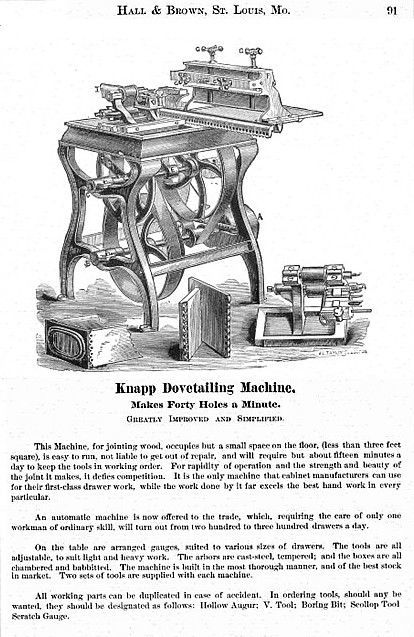
The sales re-create reads, "This Auto, for jointing wood, occupies but a small space on the floor, (less than three feet foursquare), is easy to run, non liable to go out of repair, and will require but about fifteen minutes a day to keep the tools in working order. For rapidity of performance and the forcefulness and beauty of the joint it makes, it defies contest. It is the only machine that chiffonier manufacturers can utilize for their kickoff-form drawer work, while the work done past it far exceeds the best hand work in every detail.
"An automated automobile is at present offered to the trade, which, requiring the intendance of only one workman of ordinary skill, will plough out from ii hundred to three hundred drawers a day.
"On the table are arranged gauges, suited to various sizes of drawers. The tools are all adjustable, to suit lite and heavy work. The arbors are cast-steel, tempered, and the boxes are all chambered and babbited. The machine is congenital in the most thorough manner, and of the best stock in the marketplace. Two sets of tools are supplies with each machine.
"All working parts can be duplicated in instance of blow. In ordering tools, should any be wanted, they should exist designated as follows: Hollow Auger; Five. Tool; Boring Chip; Scallop Tool Scratch Gauge."
Read the Patents:
- 1867 Patent
- 1870 Patent
- 1872 Patent
- 1888 Patent
Source: https://www.finewoodworking.com/2018/09/26/history-cove-pin-joint
0 Response to "Vintage Locksmith Two Drawer Pin Box"
Post a Comment